Saturday, November 5, 2011

Cowboy Legacy -- Discovering family photos


About 1997, when I first started researching my family history, there weren't nearly as many records online as there are today.  In those days I actually gleaned more information from Mormon church CD files than I could have found online.  I also spent an enormous amount of time writing to historical societies and county records clerks requesting information.  That's not to say there weren't some pretty good resources online back then, but a lot of them were volunteer efforts with limited data and were often slow to respond.

In those days I relied on websites, such as US Gen Web, Roots Web, and Gen Forum to submit queries, join mailing lists, and gather family vital records.  Over the years, ancestry.com acquired some of those early free websites, and in all fairness to ancestry.com, it often greatly expanded and improved what it had acquired.  Today a newcomer to genealogy can pay a subscription fee, go online. and instantly find an entire family history because of research done by others like me.  It sometimes irked me to find my research on somebody else's website, but I got over it, and now I'm just happy that it's there for others to find.

I was very lucky to have a family that saved photographs, and I've got some dandies that go all the way back to the Civil War.  For me the most amazing thing about researching family history online is the possibility of actually finding distant relatives who are willing to share their family photos of my ancestors

The photograph above was one that was in my mother's photo album.  She had no idea who the lady was.  Her album had grown over her lifetime as family members passed on and left their photos to her.  Eventually I discovered only one ancestral family had lived in Zanesville, Ohio, where the photo had been taken.  Further research yielded the fact that photographer (J.D.A. Tresize)  had spent only one (1860-61) year working at the address on the photo.  Eventually I learned the lady in the photograph was Charity Plympton. my third great grandmother.  It took ten more years to learn her maiden name from an obscure Iowa state census record.  She had been born Charity Winegard about 1815.

As a direct result of joining a mailing list in the 1990s,  I later obtained a photograph of her son Charles Plympton, my second great grandfather, in his Civil War uniform.  How cool is that?


Private Charles H. Plympton had served with Company K of the 97th Regiment Ohio Union Volunteers between 1862 and 1865.  He saw action in the Defense of Cincinnati, Battle of Perryville, Battle of Stones River, Tullahoma Campaign, Siege of Chattanooga, Battle of Missionary Ridge, Atlanta Campaign, Battle of Resaca, Battle of Kennesaw Mountain, Battle of Peachtree Creek, Siege of Atlanta, Battle of Jonesboro, Battle of Franklin, and Battle of Nashville

All in all,  I can tell you that searching for your family will yield some pretty amazing results if you stick with it long enough.  I now have photos of some distant great great grandparents born in far away places like Newfoundland (1826) and Ireland (1800).  I've also made new friends and found some distant cousins I stay in contact with today.  

I know who I am!  Do you?


Cowboy Wisdom -- Don't use a mare to lead a pack string

"Mustang Herd" ink and watercolor wash by Jerry England ©1999

In the wild horse world every horse has a job, and there is a distinct pecking order established by hooves and teeth.  Wild horse stallions are a little like a bunch of young cowboys.  Now don't get me wrong.  They don't actually hang out in the local saloon and scheme on the pretty seƱoritas, but then again they ain't much interested in locating groceries, or raisin' babies.  That job falls to the herd's mares, especially the lead mare.  Her job is to lead the herd to the best grasslands and good water holes, and to keep a watchful eye open for mountain lions and other predators. 

You can examine any corral full of horses, and you'll find a mare pretty near the top of the heap.  She always gets the best feed, and she gets it first!  And if she moves toward the watering trough, just watch the geldings scatter.  My gray mare doesn't take any prisoners, and she announces her intentions early.  The first thing she'll do is a quick whirl, then she backs up a-kickin'.

A few years back I was helpin' an outfitter wrangle horses on a dude ride up Sheep Mountain near Wapiti, Wyoming .  I was away from home, so a waddy friend of mine loaned me his ranch mare for the day.  That mare was a swell little horse.  She was plenty trail savvy and neck-reined just right.  Coming back down the mountain we stopped at a staging area, where we loaded the dudes in trucks, so they could get their land legs back before the big bar-b-que planned for later that evening.  We tied all the stock "head to tail," and us wranglers headed back to the home ranch, each leading a string of horses.  I was riding squaw-reined with four horses behind me on a lead rope dallied around my saddle horn.

Horses being what they are--grazing animals--you can depend on some trail munchin' along the way.  I guess the little gelding--first on the lead rope behind me--forgot himself for a moment because he planted himself solid to partake of some bunch grass; but as soon as the rope tugged off my saddle's cinch. the ranch mare went into action.  

You'd have thought she was a movie star at Grauman's Chinese Theatre the way she embedded her hoof prints into the gelding's chest.  He wasn't limping, but I knew he was hurt 'cause the grass grabbin' quit right then and there.

The outfitter was somewhat ticked off that one his stock horses got scared up, but for me it was valuable lesson that I added to my arsenal of cowboy wisdom.  That's why you'll never see me leading any one of my geldings behind Kasidy May--the alpha mare of our outfit.


Cowboy Legacy -- Montana stump ranch 1912


Frank Bailey, my granddad, was living in Montana by 1910.  Two of his brothers were also in the Kalispell, Montana area about the same.  His brother Marcus married Verna Woolford there in March 1910.  Another brother David was often Frank's hunting companion in Kalispell .  In September 1912 granddad married Lydia Corrina Brown, who had resided in nearby Creston, Montana.

Frank Jackson Bailey was born in Liberty Township, Valley Co., Nebraska April 29, 1886.  He was the son of David Jackson Bailey and Lillian Amanda Pierce.  Frank died March 15, 1968, in Los Angeles, California.

Lydia Corrina Brown was born in Sioux City, Iowa, September 13, 1891. She was the daughter of Abraham Lincoln Brown and Neva Genevive Plympton.  Lydia died December 25, 1971, in Granada Hills, California.

About the time of their marriage Frank and Lydia filed on an 80-acre homestead in Kalispell.  The place had been "proved up'" and was signed off by President Woodrow Wilson in 1916.


In the photo above (taken 1914) grandma is holding baby Opel who died a year later, and granddad is holding the family pup.  Below is another 1914 photo of grandma with her sister Olive.  Graddad's homestead appears to be prospering as there is no shortage of fat cattle and well fed draft horses. 


Granddad described himself as a "stump rancher" who made his living raising horses and cattle, logging, growing a vegetable garden, and hunting deer and elk to provide for his family.


As a young man, granddad must have learned logging from his father Jackson.  Before moving to Kendrick, Idaho, in 1903, Jackson had lived in Nebraska, where there wasn't a forest for more than 100 miles.  


Granddad's logging operation included cutting and splitting some of the logs for firewood, as you can see in the photo above.  Brother David is operating the small steam engine while granddad (second from the left) is piling wood.


After the wood was split, it was stacked on wagons and delivered to customers.  Those old pioneers had a lot of work to balance just to eek out a living in the harsh conditions of early Montana.


The photo above (one of my favorites) is of mom who was born in Kalispell in October, 1914, and younger brother Vernon who was born there in October, 1917.

All those old pioneers are long gone now, but they left some indelible footprints on Montana's landscape.

Wednesday, November 2, 2011

Cowboy Legacy -- Wheat farming in Idaho


My granddad had tried ranching in Montana between 1912 and 1918.  In 1918, he had an opportunity to acquire a farm near his father on Bear Ridge near Kendrick, Idaho, so he sold his Montana homestead, packed his belongings in a horse-drawn covered wagon, and headed for Idaho with his wife and two young children.

The photo above is granddad (back row, far right) with his wheat-harvesting crew about 1919 at Bear Ridge, Idaho.


Horse drawn harvester reaping wheat.  I don't know just how much farm equipment granddad actually owned, but I do know there were harvest crews that brought their own binders and reapers, and harvested wheat as contractors.


Loading loose wheat stalks on horse-drawn farm wagons.  My mom always claimed she drove one of the wagons when she was still a pretty young girl.


Granddad's threshing machine was hand-fed and horse-powered.  Those-old timers sure put in some long days.  If you look carefully you'll notice a buggy to the right of the thrashing machine.  I am betting it belonged to the photographer.


Tuesday, November 1, 2011

Cowboy Legacy -- Saskatchewan homesteader


My granddad's brother Marcus Leroy Bailey was born March 23, 1888, in Liberty Township, Nebraska, and he died May 2, 1979, in Ramona, California.  In between he packed in one heck of an adventurous life.

He married Verna Bell Woolford on March 30, 1910 in Kalispell, Montana.  Together they raised ten children.  Three of them-- Nellie, Alma, and Ruth--shared with me their research on our family history.  That was over a decade ago.  I suspect those lovely ladies have all gone to the Great Divide by now.

Not too many years back, one of Marcus' granddaughters sent me a Seattle Times story about his family's life on the prairie of Saskatchewan, Canada, where he had farmed and raised cattle.  The article focuses on the harsh conditions those early pioneers had to endure.  It also describes the family's 800-mile horse-drawn covered wagon trek  returning from Saskatchewan to Bear Ridge in Idaho, so they could farm and live near Marcus' parents.  The photo below is Marcus with four of his draft horses taken in the 1920s in Saskatchewan.  These are probably the same horses that made that 800-mile trip in 1923.  Read the story at http://seattletimes.nwsource.com/html/localnews/2003888204_wagon17m.html


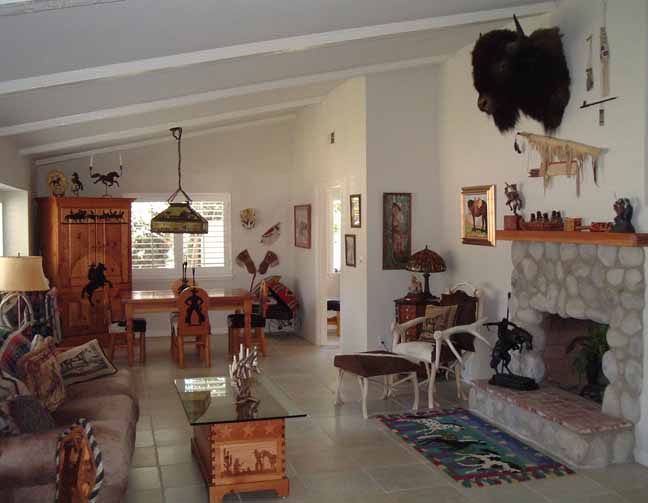
I remember meeting Marcus in Ramona, California, sometime in the 1960s when my granddad took me to his place for a visit.  I was instantly impressed by the decor of Marcus' home.  It was wall-to-wall cowboy decor.  He even had "Wagon Wheel" furniture, a product of the 1950's, with carved wood Western motifs.  Marcus and I bonded instantly, and after a little palaver, we got around to the inevitable game of horseshoes in the backyard.  I teamed up with Marcus, and together we gave granddad and dad a good trouncing.

Cowboy Chic -- Lure of the Dim Trails


Although I didn't know it at the time, 1989 was a year of crossroads for me.  I had been employed by a major California-based savings bank for quite a few years.  I had worked my way up to a senior vice-president position and was managing the operations of its home building subsidiary.  At that time the feds were forcing banks out of the home-building business, so my employer was in the process of trying to liquidate $400 million in assets.  For me it was a stressful time because my assignment was to complete 600 homes under construction, wind-down operations, and systematically layoff more than 150 employees.  For many years my hobby had been collecting and trading cowboy antiques.  In 1988, I learned about a major antique show and auction that would take place in Cody, Wyoming during the summer of 1989, so I signed on as a dealer.

While I was in Cody that summer I visited the Buffalo Bill Historical Center and was treated to an exhibit titled "Interior West: The Craft & Style of Thomas Molesworth."  I was completely captivated by Molesworth's whimsical Western-themed furniture.  Thomas C. Molesworth (1890–1977) was an American furniture designer who was a significant figure in the creation of a distinctly Western style of furniture and accessories, utilizing hides, horn (antler) and natural wood. Molesworth's style drew from the Arts and Crafts Movement and from vernacular design characteristics of Western American ranches and farms. He is credited with popularizing the "cowboy furniture" style. To produce his designs, Molesworth operated the Shoshone Furniture Company from 1931 to 1961 in Cody, Wyoming.

After seeing the Molesworth exhibit I couldn't wait to get home to try my hand at crafting my own cowboy furniture.  I started with a headboard and bench for our guest bedroom--which my wife had dubbed 'the shrine' because it was where a large part of my cowboy antiques hung on the walls.  Knowing my job with the bank would end when the last employee was laid-off, I needed to start planning my future, but I had a contract with the bank that guaranteed me a substantial severance payment if I stayed to the end.  Leaving early was not an option.  I had been in the home-building industry since 1965, the year I was discharged from the Army.  I reasoned it was time for a change.  I had always wanted to be an artist, so I poured myself into crafting cowboy furniture.  I bought some shop tools, including a table saw, band saw, and compressor.  Every hour I was not at the bank I was making furniture in my garage.


I chose "Lure of the Dim Trails" as the marketing name for my work and started a promotional campaign.  I sent photos of my art to magazines, and I started contacting retail businesses to find an outlet for my work.  By February 1992, I no longer worked for the bank, Home Magazine came out with an eight-page story about my art, the Gene Autry museum gave me a weekend show in their store, I had been included in Elizabeth Clair Flood's book Cowboy High Style: Thomas Molesworth to the New West, and I was a full-time artist creating cowboy chic furniture.   


Since 1989, my art has been featured in such well-known publications as Southwest Art, Western Horseman, Country Living, Sunset, The Los Angeles Times Sunday Magazine, Home Magazine, Yippy Yi Yea Magazine, and in the 1994 cover of Country Sampler's WEST.


Other books listing my work include Way Out West by Jane and Michael Stern; Western Design by M. J. Van Deventer; and The Whole Cowboy Catalog by Mc Queary and Wallis.  Home and Garden Television's Carol Duvall Show (Episode CDS-1121) featured my Western Furniture November 13, 2001.


During the next decade I created hundreds of pieces  and shipped them to at least 32 states and five foreign countries.  By 2002, the cowboy high style fad was dwindling, and I found myself seriously involved in the San Fernando Valley's effort to secede from Los Angeles.  Given my obsessive personality, I've never been good at juggling more than one thing at a time, so it was time to move on to new pastures.

For more of my folk art see the YouTube video http://www.youtube.com/watch?v=fAQQBNwyig4

Afterword -- almost a decade later...
I closed the door on Lure of the Dim Trails in 2002 and became a community activist fighting to protect horse-keeping in Chatsworth.  I ran for Valley City Council during the Valley's attempt to secede from Los Angeles.  When secession failed, I joined the newly-formed Chatsworth Neighborhood Council and formed an equestrian committee and created the Chatsworth Day of the Horse.  I left the neighborhood council in 2007, and spent the next three years writing two books about Chatsworth's movie location history.  Today I lecture and sell my books at various community events.  To learn more please visit http://www.cowboyup.com/


Cowboy Culture -- Unlikely compaƱeros


After the 2002 San Fernando Valley bid to secede from Los Angeles was lost, savvy politicians with connections to the Valley reached out to their disenfranchised citizens to once again win their support.

The City of Los Angeles established neighborhood councils to give citizens an open forum for public discussion of issues concerning their community and to facilitate communication between the City of Los Angeles and community stakeholders.

In 2004, I ran for the Chatsworth Neighborhood Council, and won a seat on its first elected board.  Within weeks I organized the equestrian and land-use committees, and was elected chairman for both of them.  I established the Chatsworth Day of the Horse (DOTH) and Equestrian Safety Month to promote a better understanding of horses, and the need for motorists to slow down and share the road.  The idea was simple:  We would have a community event--Chatsworth Day of the Horse (DOTH)-- that would give non-equestrians a chance to see up close horses, their riders, and some equestrian skills.  Equestrian Safety Month would be the month preceding the DOTH, and free yard-signs advising motorists to "slow down, and pass wide" would be distributed to the community to put in their front yards.  To get school children to help carry the message to their parents, we also sponsored a horse- safety poster contest with cash prizes and awards to be presented at the Chatsworth Day of the Horse.


Los Angeles County Supervisor Michael Antononvich saw the merits of my Equestrian Safety Month idea and in 2004 proclaimed the month of April as "Equestrian Safety Month" throughout the County of Los Angeles  to encourage safety and to educate motorists and equestrians about the rules of the road to prevent accidents and injuries where cars and horses cross paths.


Then mayoral candidate Antonio Villaraigosa came to the second Day of the Horse (2004) to make a campaign speech.  Later, keeping his campaign promise to me, Los Angeles Mayor Antonio Villaraigosa came to Chatsworth in September, 2005, to go for a horseback ride to see firsthand our priceless heritage of horse-keeping, equestrian trails and open space that we had been fighting to preserve.


Councilman Greig Smith won election in 2003, and became a stedfast friend to Chatsworth's equestrians.  In 2004, when I had shoulder surgery to repair a ruptured tendon, Greig presented me with a 'gentle horse' to ride until my doctor released me to get back on my horses.  Councilman Smith was instrumental in acquiring Stoney Point Ranch, a private boarding facility, that otherwise would have become just one more housing tract.  Instead it is now a city-owned horse ranch and is part of the city's park system.


Afterword -- almost a decade later...

Greig Smith's longtime Chief of Staff and also my friend, Mitchell Englander (on the palomino horse above) was elected to the Los Angeles City Council in 2011.  I know Mitch will continue to help fight to protect horse-keeping in Chatsworth.  As for me I left the neighborhood council in 2007, and spent the next three years writing two books about Chatsworth's movie-location history.  Today I lecture and sell my books at various community events.  To learn more please visit http://www.cowboyup.com/

Councilman Smith, Mitchell Englander, and I worked to create a Share the Road sign campaign to make our streets safer for motorists, horses and riders.  See the "Ride Safe" video on YouTube http://youtu.be/3-ejyRTYPvw