Wednesday, November 9, 2011

Good 'Uns -- horses, trails, and friends


During all the years I participated in the Old West Show and the Western Design Conference in Cody, Wyoming, I was very fortunate to have made some good friends and to have been invited on some great trail rides.


The photo above is a small group of cowboy antique dealers who were treated to a super ride organized by Brian Lebel (third from right).  The outfitter that provided the horses was a gent named Bob DeRoche.  

Others in the photo are (left to right) unknown, Joseph Sherwood, Dave Jeffers, Jerry England, Linda Kohn, Bob DeRoche, unknown, Brian Lebel, Mary Schmitt, Jeff McManus and Katie (Jeff's border collie).

(left to right) Bob DeRoche, Jerry England and Jeff McManus

I got to know Bob DeRoche pretty well.  He gave me a border collie mix pup in 1996--I named him Billy--and sixteen years later he's still a big part of my family.

Billy in his--saddle pad--bed on the dash-board of my old motorhome

Linda Kohn and Joseph Sherwood are the owners of High Noon in Los Angeles, and the organizers of a wonderful antique show and auction that has taken place in the Phoenix, Arizona area for more than twenty years.  Mary Schmitt is the owner of Cayuse Americana in Jackson, Wyoming.  Jeff McManus was a Wyoming brand inspector and sometimes outfitter.  Bob DeRoche owns High Mountain Outfitters and at one time also owned Cedar Mountain Trail Rides in Cody.


The photo above was taken in 1996 by Willam Manns photographer and owner of Zon International Publishing, Santa Fe, New Mexico.  I'm not sure who all was there, but they were all dealers in Brian Lebel's Cody Old West Show.  You can bet everyone had a great time.  Yee Haw!


In 1999 a bunch of my friends in Los Angeles decided they wanted to see the beautiful Wyoming trails I had been braggin' about, so they asked me to arrange a ride.  I called my old friend Bob DeRoche and fixed a date in late June.


Bob took us to Kirwin, a ghost town on the Wood River near Meeteetse, Wyoming.  My buddies all owned horses and were good riders, or Bob won't have taken us to Kirwin which sits at 9000 feet. 


The 26-mile ride took us through grizzly bear country, above the timberline on scree slopes, across snow banks (where the horses slid downhill); and we criss-crossed the Wood River dozens of times.


We kept company with the local elk and moose population.   Much to everyone's satisfaction, we didn't encounter any bears.


The high point of the Kirwin ride was at an elevation 12,000 feet--pun intended :-)

Cowboy Culture -- working cowboys


My friend Roger Miller (far left) had worked as a cowboy on Santa Rosa Island back about 1956.  Later in the early 1960s, he worked on Rancho California near Temecula.  Roger thought the most beautiful animal in the world was a new-born calf.  I sure learned a lot about horses from him.

Funny thing is that most real cowboys are proud of what they do for a living, and they ain't much bothered by what other folks think.  Come to think of it I guess most waddies just naturally follow that ol'  piece of cowboy wisdom: "Don't interfere with something that ain't botherin' you none."


Back in 1995 I was building "cowboy furniture" and the "world wide web" was just getting' started, so it seemed to be a good idea to create a website.  Unfortunately cowboy.com was already taken, and cowboy_furniture.com seemed too long.  My wife suggested cowboyup.com which was available, so I took it.

About 1997 some outfit figured they had a better right to the name cowboyup.com, so they hired an attorney who told me I was about to get sued for using the name, and a "Molesworth" cowboy silhouette for my logo.  I guess they weren't aware of another bit of cowboy wisdom: "Keep skunks, lawyers and bankers at a distance."  That attorney really irked me, so I retained my own attorney, and documented all the books and magazine articles about my art that displayed that "Molesworth" cowboy silhouette.  That attorney had to admit his mistake, apologized to me, and paid my legal bill.


About that same time I got an email from a fellow who said he was a working cowboy and it wasn't right for me to profit from claiming to be a cowboy while he was starving to death out on the lonely prairie, his poor little wife waiting back home in the family single-wide.  No kidding, that's basically what he claimed, but it just didn't track.  I knew there was no way he was a cowboy.  How would a REAL cowboy out on the range have time to look at my website or even give a d--- for that matter.  Curious,  I "netscape-searched" his name and email address (Google didn't exist yet.  I discovered he was definitely not a real cowboy.  He was just plain nuts.

All the above raises the question: What is a Cowboy?

The Merriam-Webster Dictionary defines a cowboy (noun) as:

1 : one who tends cattle or horses; especially : a usually mounted cattle-ranch hand

2 : a rodeo performer

The American Heritage Dictionary defines a cowboy (n.) as:

1. A hired man, especially in the western United States, who tends cattle and performs many of his duties on horseback. Also called cowman, cowpoke, cowpuncher, also called regionally buckaroo, vaquero, waddy.

2. An adventurous hero.

Will James wrote, "A cowboy is man with guts and a horse."

John Wayne's comments about old-time cowboys:

They were simple, direct men.

They believed in things like liberty and minding their own business.

When the first cowboys were herding longhorns up the Chisholm Trail from Texas to Kansas, they were a pretty tough lot, but they had to be. It was a rough era in our history. There was no room for nuance or no time for luxury.

Out of the lives of these cowboys have come all sorts of stories and legends, Some true and some fiction. But the most authentic and dependable evidence of what the cowboys really were has come from the artists who pictured them in their true environment, risking their lives in stampedes, freezing or sweating, under the stars, by lonely campfires, rowdying in saloons, fighting, branding and whooping it up around the chuck wagons.

California rancher's credenza crafted by me about 1995

Short on cowboy credentials, but what I have I learned the hard way

So I guess if you're a genuine working cowboy, and you're annoyed by my calling myself a cowboy, I ought to give you my apology.  On the other hand, I once worked as a cowboy when I was a teenager.  I had been hired to help a young Ahwahnee, California rancher gather his cattle so he could run them through a dipping vat, vaccinate and deworm them.  That was the year I discovered I was allergic to poison oak.  It was a hot summer--most days were over 90 degrees--and where my body came in contact with my saddle, there wasn't a spot that didn't have a swollen, itchy red rash.  I spent every night sittin' in a tub full of watered-down bleach.  Later I got a series of shots and never again got a reaction to poison oak.

Scourge of the West

I am the scourge of the West,
More outrageous than the rest.

I will creep along the canyon floor
Till I come knocking at your cabin door

And to you it will be no joke
For you see my name is poison oak

© Jerry England 1999

 In his book  "Cowboy Culture," David Dary wrote: "The cowboy symbolizes the free life, closely tied to the out-of-doors and Nature. The impact of land, the grass, the rivers and streams and gushing springs, the color of the sky and the clouds, the climate and the weather, these things are characteristic of the real and the mythical cowboy cultures."


Cowboy Legacy -- Mountain Brook homestead


The photo above is (left to right) Neva (Plympton) Brown, Stella Brown, and Abraham Lincoln Brown, taken about 1890 in Polo, Missouri.

Abraham (Abe) Lincoln Brown was born in Philadelphia, New York, November 25, 1864.  He died August 8, 1948, in Creston, Montana.  Abe grew up in Bradford, Wisconsin during the 1870s and 1880s, where his father worked as a logger.  Abe married Neva Genevive Plympton in Roswell, South Dakota, March 1, 1888.  Neva was born in Zanesville, Ohio June 2, 1870.  Neva died April 8, 1939, in Creston, Montana.

Abe and Neva made several long distance moves seeking the right place for a home.  Census records and their children's birth records show that they were living in Rodman, New York in 1900.  Daughters Stella and Lydia were born in Sioux City, Iowa 1889 and 1891, respectively.  Two additional daughters and a son--Olive, Emma, and Alonzo--were born in New York in 1893, 1896, and 1898, respectively.

In 1901 Abe Brown filed for homestead and constructed a house on land in Creston, Montana.  The place, consisting of 151.90 acres was "proved up" on June 4, 1912, and was signed off by President William Howard Taft.


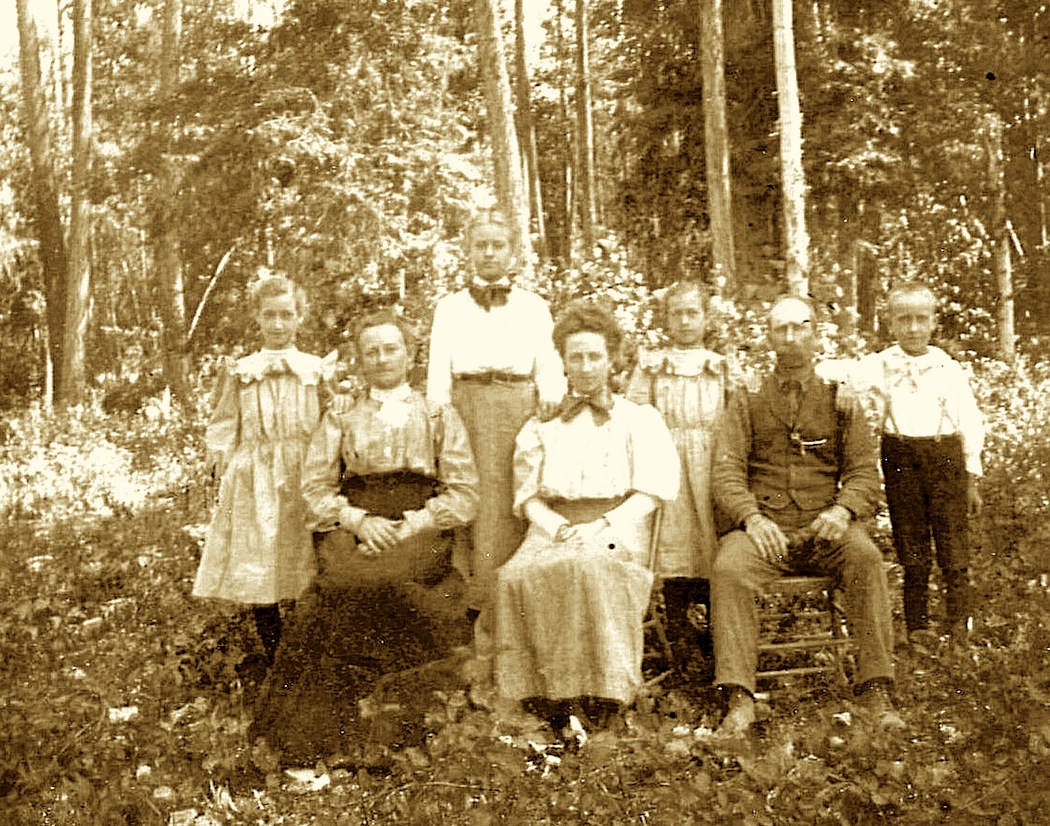
The photo above was taken about 1905 on the homestead in Creston.  In the photo (front row, left to right) are Neva, Stella and Abe (back row, left to right) are Olive, Lydia, Emma, and Alonzo "Lon" Brown.  There was a creek running through the property, so the homestead became known as "Mountain Brook."


The 1928 photo above is of Abe Brown with his dogs Lady and Muggs at Mountain Brook. 


Above is another 1928 photo of Hazel Bailey, Lon Brown, and grandma Brown's cow taken at Mountain Brook.


"Mountain Brook" as it appeared in the 1940s.


Solo canoe camping -- equipment checklist


I've been on several wilderness canoe trips, including some in Minnesota's Boundary Waters Canoe Area, Canada's Algonquin Park, and Montana's Upper Missouri River.  I've also gone on plenty of weekend adventures to local rivers or lakes.  

Whether you're planning a lengthy wilderness canoe trip or just an overnight campout on your favorite lake, it's a good idea to develop an equipment checklist so you won't overlook some essential item necessary for a safe outing.

It also makes sense to be sure everything will fit in your canoe.  A few days before leaving on a trip, I always pack my gear in dry packs and position them in my canoe.  Be sure to weigh your packs to make sure your equipment doesn't exceed the total recommended weight capacity of your watercraft.  The last thing you want is to arrive at a lake 300 miles from home and then discover it won't all fit or that you forgot your sleeping bag.


As you can see in the photo above, my 12' Old Town pack canoe doesn't have a lot of extra space.  There's just enough room left for me and my fishing tackle.

It's important to lash your gear in and keep the center of gravity low to avoid problems in the wind.  I use a couple of 25' lengths of 1/4" bungee cord and aluminum carabiners to lash everything to the thwarts and carry handles.

My solo canoe camping checklist

• 12' Old Town Pack canoe or 14' Old Town Hunter canoe
• carlisle wood paddle and carlisle double paddle tied to thwart with bungee
• wear: nylon underwear, polyester undershirt, wool or nylon shirt, wool whipcord pants, 
  web belt, and Columbia water shoes
• wide-brim felt hat and polarized sunglasses on lanyard
• bear spray on belt (bear country)
• .45 caliber, 20" barrel puma carbine; scabbard; ammo; and cleaning kit
• Fenwick spinning rod with Mitchell 300 reel rigged with Rapala lure --alternate-- 
  Kencor trolling rod with Penn Mag 10 reel rigged with lead-core line, Dave Davis flashers, 
  and Rapala lure (depends on time of year and depth of lake--sometimes I take both)

essentials bag (large green dry pack):

• pfd with knife, whistle, compass, watch, and waterproof camera with extra battery
• two painters and bungee ties
• seat back with seat pad
• bailer and sponge
• topographic map in waterproof case
• fishing net and fish billy
• Scotty clamp-on fishing rod holder
• extras bag (see below)
• fishing tackle bag (see below)

extras bag--inside essentials bag (small blue dry sack):

• Gore-Tex paddle jacket, nylon rain pants, and polyester gloves
• plastic trowel, and toilet paper in ziplock bag
• mini roll duct tape
• small orange dry sack with wallet and keys
• mosquito net
• wool watch cap

waist pack (inside extras bag)

• first aid kit and survival booklet
• headlamp
• air horn in ziplock bag
• sunblock
• insect repellent
• magnesium fire starter
• lip balm
• handkerchief
• survival fishing kit
• folding knife

Flambeau Kwikdraw fishing tackle bag, and carabiner--inside essentials bag

• 3 plastic tackle boxes
• extra flashers, line, and leader
• stringer
• needle nose pliers with bungee tie
• extra spinning reel
• fishing license

sleeping gear bag (large yellow dry pack)

• tent with fly, poles, stakes, ground cloth, mosquito net, and stuff sack
• folding camp stool (optional)
• rain fly and 100-feet para-cord
• camp axe and folding saw
• sleeping bag
• air mattress
• rain parka with hood in stuff sack--also serves as a pillow

large clothing stuff sack (inside sleeping gear bag)

• nylon undershorts, 1 per day
• polyester undershirts, 1 per day
• wool socks, 2 per day
• moccasins (in ditty bag)
• nylon or wool shirt, 1 per day
• wool whipcord pants, 1 pair
• bandanas, 1 per day

kitchen bag (medium clear dry sack)

• Katadyn water filter pump and quart bottle (replaces 2 gal jug in plastic box--photo above)
• small flashlight
• fillet knife, sharpening stone, and cutting board
• kitchen knife, fire starter, and can opener
• aluminum grill and copper wire
• garbage bags and ziplock bags (large and small)
• matches, lighter, and candle lantern
• nesting pots, 10" fry pan, and spatula
• plastic plate, bowl, cup, knife, fork, and spoon
• measuring cup
• coffee drip cone and filters
• salt and pepper shaker
• camp suds and pot scrubber
• dish towels and pot holder
• collapsible bucket
• 50' rope to bear-proof food bag (10’ up - 10’ away - 4’ down, dark color)
• Mountain House Freeze-Dried meals, coffee, Tea, and snacks (in dry bag)

 personal toilet items in ditty bag (inside kitchen bag)

• medicine: aspirin, prescriptions, and ibuprofen
• toothpaste and brush, hair brush, and deodorant
• Malox and Benadryl
• sewing kit and extra batteries in plastic jar
• camp bath towel
• stuff sacks with fresh and freeze-dried food

mesh bag

• Peak One camp stove in a case, fuel bottle, and funnel
• rod and gun oil in ziplock bag

14' Old Town Hunter canoe pack check.


Saturday, November 5, 2011

Cowboy Legacy -- Bailey cowgirls


Jackson Bailey's daughters might not have been rodeo cowgirls, but they were no strangers to horses.  The photo above is Clara Bailey riding her dad's saddle horse about 1913.  No need to adjust the stirrups, just shove your feet into the stirrup leathers,  giddy-up and go.


The photo above, taken during World War I, is of Meda Bailey wearing her big brother's campaign hat while wrapped in the "Stars and Stripes." The Baileys were a patriotic lot who knew that their very own ancestors had fought the Civil War and Revolutionary War to guarantee their liberty.  Two of Jackson's sons, my granddad and his brother David, joined the Montana Militia just in case.  


The photo above is a 1920s postcard from one of granddad's sisters-in-law (I'm not sure which one).  Those pioneer ladies had no trouble riding a saddle horse while carrying an infant in their arms.


Here's another 1928 photo.  This one is my aunt Hazel and a cousin riding one of Grandpa Brown's horses in Creston, Montana.  Now that they're all gone, I can freely admit that Hazel was my favorite aunt.  She was a real trooper who could hunt and fish with the best of 'em.


Cowboy Legacy -- Early Montana schools


The photo above of Lydia (Brown) Bailey's 1905 souvenir from Cayuse Prairie School must have been akin to the modern day yearbook.  The extraordinary thing about this souvenir is that it lists all of the Brown siblings: Stella 17, Lydia 14, Olive Brown 12, Emma 9, and Alonzo 7.


The photo above was taken at Cayuse Prairie School (in Creston, Montana) about 1905.  Grandma is second from the left in the front row (wearing a gingham check dress).


This photo of Cayuse Prairie School gives you a pretty good idea of how it got its name--minus the cayuse.  That's the outhouse at the far left of the photo.


A few years later grandma's sister Stella was the teacher at yet another rural Montana school somewhere near Kalispell.


Cowboy Legacy -- Belgian horses


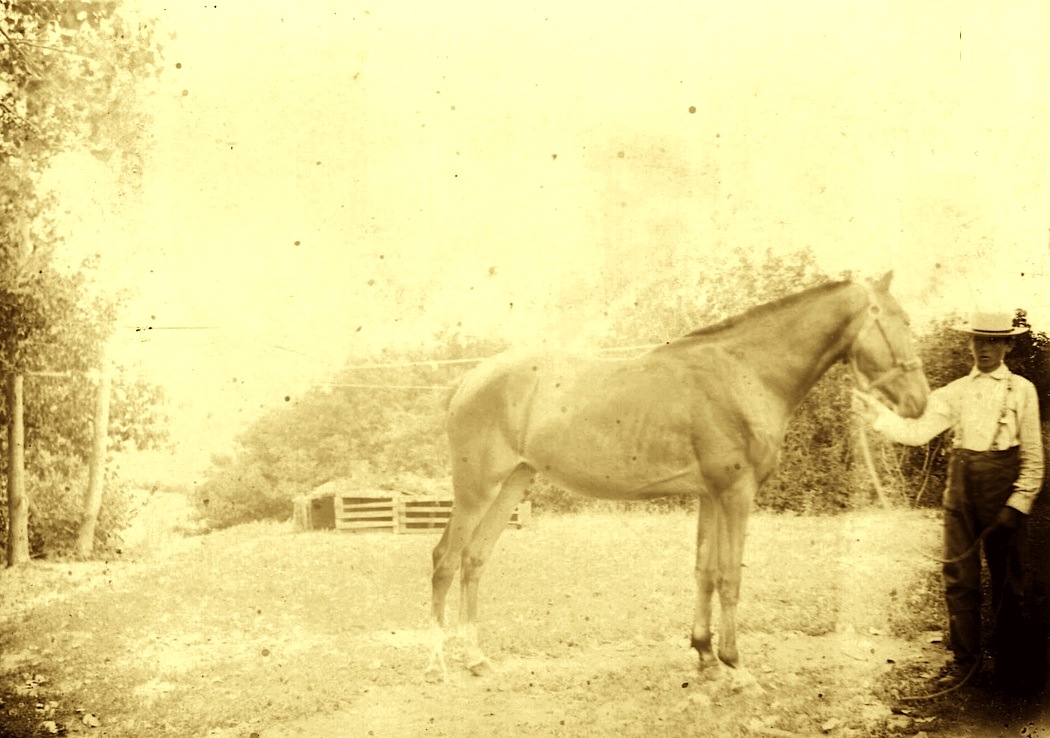
The  young boy in the photograph above is my granddad (Frank Bailey 1886-1968) with his prized Belgian colt. Belgians were the strongest working horses in the world (Now they are primarily used for parades and shows). The photo was taken about 1898 in Liberty Township near Comstock, Nebraska.
Granddad raised Belgian horses most of his life.  I know his grandfather (David Solomon Bailey) had a Belgian stallion in the 1860s when worked as a teamster--after he losing a leg in the Civil War.  I'd say there was a pretty good chance the reverence for Belgian horses had been passed on from father to son for at least three generations.  


Granddad was proud of the fact that he had been born in a sod house on the Nebraska prairie.  I still have the certificate that he got in 1955, making him an official member of the Sons and Daughters of the Soddies.  It hangs with honor in a special place in my home.


This photo of granddad and his family with a new colt was taken in Lewiston, Idaho about 1927.  As you can see he was still raising Belgians.