Thursday, November 10, 2011

Cowboy curiosity -- Little horses, big personalities


For the past 400 years, paintings by European artists have left us ample proof that little horses had been bred as pets for the children of royalty.  Historical records also suggest small horses were often present in the courts of Europe as popular curiosities.  King Louis XIV of France kept a zoo with all sorts of unusual animals, including tiny horses.  As the popularity of the miniature horse grew, they gained distinction as eager performers in traveling circuses.  The true origin of these little horses is still debated, and the exact origin may never be known; however, because of their heavy shaggy coats, some folks believe they may have originated from small icelandic horses, where weather conditions are cold and harsh.  By the 1950s there were all sorts of small horse breeds around the world, including the Miniature Shetland Pony, the Miniature Toy Horse and the Midget Pony.

Wherever they originated, eventually miniature horses became useful as working horses in the coal mines of Great Britain where they were called "pit ponies."  During the 1800s pit ponies were often imported to the United States to work in Appalachian coal mines.  By the 1970s, with the coal-mining days over, breeders refined miniature horses and began using them to drive pleasure carts.  In 1978 the American Miniature Horse Association (AMHA) was formed to adopt a standard for the breed, maintain a stud book, and keep a registry.  Today, the AMHA has nearly 150,000 registered horses.  Adult miniature horses under 34" at the withers are considered "A" division miniature horses.  Those over 34"up to and including 38", are considered "B" division miniature horses.


My little horse is Biggs, short for "Big Enough."  He's a "B" miniature horse that stands 38" when his hooves are freshly trimmed.  He has participated in several Chatsworth Day of the Horse events, and he loves giving children cart rides.


Biggs is also a bit of a ham and was an eager performer during his own liberty class at a show in 2004.


In 2007 Biggs (with driver Eddie Montano, age about 10) pulled this covered wagon for the entire length of the Chatsworth Holiday Parade.


If you see us on the road, please give us a break and pass us carefully.  We are always courteous and try to stay to the right, out of the way of traffic.  In California horses (all sizes) still have the right-of-way over vehicles, but most folks don't know that.


Cowboy Culture -- Metrolink trains

Just over a decade ago, the Southern California Regional Railroad Association (SCRRA) and Metrolink announced their plans to double track the railroad right-of-way through rural Chatsworth.  Chatsworth's equestrians voiced their opposition, but the SCRRA did exactly what it had planned,  with no regard for our concerns.  At the time I warned that those double tracks would cause an accident and somebody would get killed.  

Then on Friday, September 12, 2008, in Chatsworth, a Metrolink engineer failed to obey a signal light that caused a deadly head-on collision with a Union Pacific freight train.  The wreck claimed 25 lives, injured 135 others, and resulted in financial losses in excess of $7,000,000.  The following poem was my warning eight years earlier:

"Workin' out the Kinks" by Jerry England © 2000

Metrolink

She toots her horn and goes by in a wink,
This new iron horse called Metrolink.
Runs next to our trail, making noise and dirt
An' I can't get my pony near it, even with a quirt.

Now railroads are nothing new to the West,
At wiping out buffalo and Indians they are best.
Rail barons and politicians, they all got wealthy
but for you and me, trains were never healthy.

An outfit called the SCRRA, without a bit of tack,
Has announced it's gotta add a second track.
New ties and rails just ten feet from our trail
“We'll even add a concrete wall too,” they regale.

Now picture my old horse down in this concrete ditch
A big locomotive over his head coming off the switch
Rails squealing, horn screaming, and horse bucking as we fall
It'll sure be a wreck when my head crashes into that wall.

The SCRRA doesn't give a hoot for my horse’s safety or me
Our trail will be lost and maybe a few lives, too, don't you see.
But you know they’re gonna have that second railroad track
Just so they can take a few more folks to work and back.

It’s interesting to look back at the history of the railroad
The first trains were pulled by horses, I've been told.
Our riding trail will be lost for lack of safety and use,
An’ Metrolink will continue its history of public abuse.

© Jerry England 2000

Another tragedy -- Horse and rider killed by Metrolink train

From KABC News, February 11, 2011, Sun Valley, CA:  A horse and rider were killed Friday afternoon by a Metrolink train in Sun Valley, Los Angeles.  The horse and rider were on the tracks near San Fernando Road and Sheldon Street when the train hit them shortly before 4 p.m. Los Angeles City Firefighters say the 38-year-old man and his horse died at the scene.

Cowboy Culture -- Making of a cowgirl

When she agreed to marry me--nearly 40 years ago--I was a carpenter, and she was a high school English teacher.  The last thing she ever figured would happen in her life was horses.

But, I had grown up with horses and always planned on having them in my life again when the time was right.  This is the brief story of the "Making of a cowgirl."


Jerry and Joyce (1972).


Joyce with her first horse, 20-year-old Star (1996).  When we were hanging out at the boarding ranch--way up in Browns Canyon--where Sunup was living, a lady asked us if we'd like a free horse.  I talked Joyce into taking the offer.  At age 58, Joyce began her journey as a horse owner.


"Leader of the Pack" Joyce with (l to r) Annie Oakley, Bronco Billy, Rusty, Cash (1998).  Within a few months of riding, Joyce was dumped off old Star and suffered some compression fractures in her back.  She was the true definition of "cowboyup" because within a few months she was back in the saddle.  It didn't take long before she was ready for a better horse, and in 1997 she acquired 7-year-old Cash, a reining horse with a quarter horse pedigree that goes back to Poco Bueno.


Joyce learning to harness and drive Biggs (2001).  Some of our friends and neighbors owned miniature horses and had lots of fun driving them.  We bought 4-year-old Biggs and a Meadowbrook cart.  Over the years Joyce and Biggs have participated in parades and other equestrian events.


Jerry on Cash and Joyce on Zinger high above Morro Bay in Montana De Oro State Park, California (2002).  To learn more about Montana De Oro State Park see http://a-drifting-cowboy.blogspot.com/2011/10/cowabunga-surfs-up-dude.html


Joyce and Zinger in the rocky hills of Chatsworth, California (2004).  The extraordinary sandstone outcroppings in Chatsworth attracted filmmakers a century ago.  Since then the rocky hills of Chatsworth have become a visible Western icon.


Ridin' comfortable in the saddle -- Joyce and Zinger on a trail ride (2006).


My best girls -- Kasidy and Joyce (2008).


"Field of Flowers"  -- Joyce, Rusty, Katie, and Teddy Blue on a hike (2010).

Wednesday, November 9, 2011

Cowboy Legacy -- Itchy feet and Oakhurst

Uncle Lon's Kalispell, Montana home, 1950
Dad wasn't a cowboy.  He didn't come from a family with a Western heritage.  If fact, his father emigrated from England in 1910, and his mother emigrated from Canada about the same time.  I'm pretty sure the first time he ever rode a horse was at mom's uncle's place in Montana in 1950.  Nevertheless he took to horses in a big way, and before long we had horses in our backyard.


Dad was a home builder, so he made a pretty fair living, but he always had "itchy feet," and couldn't stay in any one place too long.  For that reason, in 1957 we moved to the little hamlet of Oakhurst in the High Sierra Mountains.


One thing about dad was that he could build almost anything.  A couple of years before we moved to Oakhurst he had built his own horse trailer (photo above).  That trailer wasn't fancy, but it sure got the job done.  By the time he moved us to Oakhurst--actually we made a brief 60-day stop in Ahwahnee eight miles from Oakhurst--he had gotten rid of all the horses, but mine.  I wonder if he ever regretted that decision because there were some great trails right out of our back door in Oakhurst.


In less than two months, dad had built a two-bedroom house, a pump house, a hay shed, and a small corral .  He never got around to building a barn because by 1960 he had itchy feet again.  Poor ol' Sandy--my red dun quarterhorse--had to learn to deal with the elements--rain and snow.


I loved living in the mountains.  I could fish for trout and swim in the Fresno River not 300 yards from our front door.  I could hunt deer and quail in our backyard, and I could ride Sandy for miles without seeing anyone.


It's funny how things work out because a decade later dad was working for me when I was framing vacation cabins in Big Bear Lake, California.  That summer I traded a table saw for an old horse with free pasture.  Sadly I had to give up that horse when winter came, and the weather forced me to move back to Los Angeles.  It took another twenty years before I owned another horse.


How can you tell if a fisherman is lying?

Fishing is a family tradition -- Mike 1970


Acorns on a stump

I was fishing on a river bank one day when I happened to notice a bunch of acorns on a tree stump near me.  The stump was about eight feet out from the bank.

A few minutes later, I saw a squirrel chattering on the bank opposite that stump.  Then suddenly I saw him back off and take a running leap at the stump.

While the squirrel was in mid-air, a huge trout leaped out of the water and grabbed him.  

But the strangest thing was a few minutes later that same trout put a couple more acorns on that stump.

Frogs for bait

Joe and I were canoe fishing for bass one day.  We were using frogs for bait, and the fishing had been fantastic.  

When Joe used the last frog I suggested we paddle to shore, so I could find some more frogs.

I searched high and low and couldn't find any frogs, so I started back to the canoe.  Then I spotted this little black snake with a frog in his mouth.  I quickly grabbed that snake and wrestled the frog from his month.

As I was leaving I looked down and noticed the horribly dejected look on that snakes face.  I felt terrible, so I took out my hip flask and poured a shot of whiskey down the black snakes throat.

The strangest thing was a few minutes later--back in the canoe--I felt a tapping on my knee.  I looked down and there was that same black snake with another frog.


My dad (center row, far right) developed his love for fishing when he was growing up in Michigan during the 1920s.


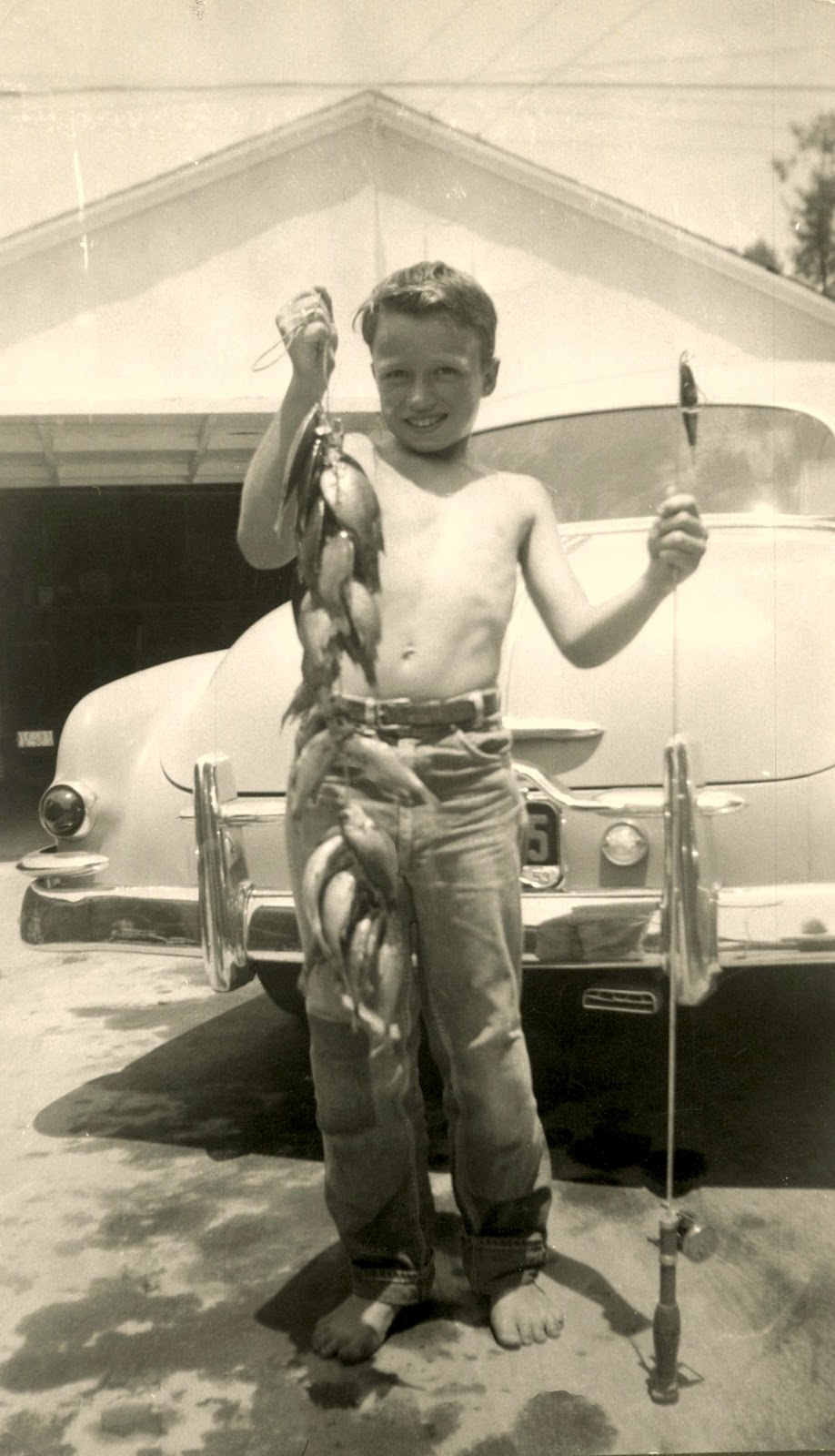
Thirty years later dad introduced me to fishing at Lake Sherwood in Southern California.  In the 1952 photo above, I'm holding dad's steel fishing rod with a bait casting reel, and a jointed bass plug.  I remember the reel he gave me to use was an old fly reel, so his outfit must have been a prop for the photo. 


In their later years mom and dad lived in Sacramento, California, where they fished both the American and Sacramento rivers.   Mom was sure tickled with the striped bass (in the photo above) it was her biggest fish ever.

To tell if a fisherman is lying--check his lips.  If they're moving, chances are he's lying.


Cowboy Culture -- The Anomaly

In one of my earlier posts I told you the story about "Canadian whiskey and the paint mare."  I traded that mare a couple of months later for a pretty nice 12-year-old palomino named Sunup.  Eventually I brought Sunup to California where we spent the next decade riding the rocky trails of the Santa Susana Mountains together.  Today Sunup is 27 years old, and is retired in my backyard.

About the time I brought Sunup to California I had acquired a nifty 1930s slick-fork Visalia saddle that fit both of us to a T.  Sunup and that old saddle with its tapaderos inspired a poem I titled "The Anomaly."


The Anomaly

Now ol’ Sunup holds his head up high,
Pretty little golden horse wants to be on the fly.
Old long tapaderos swingin’ from my Visalia tree,
Braided rawhide hackamore with a horse-hair mecate.

Just ridin’ in that California sunshine,
Just ridin’ that ol’ palomino pal o’ mine,
Rockin’, Rollin’, Ridin’.

The Old Man's best display must be the break of day
When through oak leaves shines Sun's first golden ray,
And out on a limb a steller’s jay is a-squawkin’
While cowboys sit around a camp fire a-talkin’.

Just ridin’ in that California sunshine,
Just ridin’ that ol’ palomino pal o’ mine,
Rockin’, Rollin’, Ridin’.

We're listenin’ to the call of those valley quail,
Ridin’ up that blue shadowed canyon trail.
Cottonwoods and sycamores, and a live oak tree,
Tall green grass and a babblin’ brook beside me.

Just ridin’ in that California sunshine,
Just ridin’ that ol’ palomino pal o’ mine,
Rockin’, Rollin’, Ridin’.

We're rockin’ to the rhythm of a creakin’ saddle,
Just gatherin’ up them white-faced cattle.
Coyote slinkin’ through the brush with head slung low,
Redtail hawk soarin’ above the valley below.

Just ridin’ in that California sunshine,
Just ridin’ that ol’ palomino pal o’ mine,
Rockin’, Rollin’, Ridin’.

There's a bobcat in the willows a-starin’ at me
And a big ol' mountain lion we'll never see,
But my little pack horse Star is followin’ behind,
And like old Sunup and me, he’s the happy kind.

Just ridin’ in that California sunshine,
Just ridin’ that ol’ palomino pal o’ mine,
Rockin’, Rollin’, Ridin’.

Grazin’ up on that ridge beyond
Is a mule deer doe and her little fawn,
And I know it’s the Indian’s "berries ripe" moon,
When I find plenty of new sign from brother raccoon.

Just ridin’ in that California sunshine,
Just ridin’ that ol’ palomino pal o’ mine,
Rockin’, Rollin’, Ridin’.

Old oak tree with limbs so gnarled and bold,
Please tell me a tale about the vaqueros of old,
Of a time when the golden bear still roamed free
And old Star, Sunup and me weren't an anomaly.

Just ridin’ in that California sunshine,
Just ridin’ that ol’ palomino pal o’ mine,
Rockin’, Rollin’, Ridin’.

© Jerry England 1997


Read the tale "Canadian whiskey and the paint mare" at http://a-drifting-cowboy.blogspot.com/2011/10/canadian-whiskey-and-paint-mare.html


1995 photo of me and the paint mare Amigo taken in Cody, Wyoming (Heart Mountain in the background).


3rd Iowa Cavalry


3rd Iowa Cavalry

It was early spring during the year of 1864,
He was off to serve in America's Civil War.
He rode with Company G, 3rd Iowa Cavalry.
For you see he never did believe in slavery.

While at Brices Cross Roads his leg was lost,
He was wounded severely his life it almost cost.
An' late during that day it was a final twist of fate,
When a black man found him before it was too late.

He sure must have been a hail an' hearty soul,
For later that year to his family home he did go.
He was David Bailey, great great granddad to me,
An' I know he was proud to have served for our Liberty.

© Jerry England 1999