Saturday, November 12, 2011

Cowboy Legacy -- The short, tragic life of Marcus Pierce

1875 Marcus Pierce photo obtained from descendants of Anna Nary Pierce Moses

At age 7 Marcus was without a father

What happened to James L. Pierce has never been determined.  Did he die, divorce or abandon his wife and children?  When the Federal census was taken in 1850, Marcus, his mother Elvira, and two sisters (Mary and Ellen) were living in the household of William Cory.

Elvira Brayman Pierce married William Cory 8 Feb 1849

At age 20 Marcus was a soldier in the Civil War

Marcus enlisted in the Union Army on Sept. 8, 1862, and served as a Corporal with Company E, New York 109th Infantry Regiment.  He mustered out on June 4, 1865, in Washington D.C.  At the time of enlistment he was described as five feet ten inches high, light complexion, blue eyes, brown hair, and by occupation when enrolled, a painter.

Marcus married (1) Amanda M. Hallowell April 18, 1866, in Philadelphia, Pennsylvania.  Amanda was born July 21, 1849,  in Philadelphia, Pennsylvania.  She was the daughter of Amanda Meirio and Lt. Rifford R. Hallowell (1816-1864) who served with Company K, 28th Regiment, Pennsylvania Infantry as a Second Lieutenant.   

Marcus and Amanda had three children:

Lillian Amanda Pierce (1867-1957), my great-grandmother, married Jackson Bailey in 1885. She lived  to be 90.
Charles Morton Pierce (1869-1869) died in infancy, age 5 months, 27 days.
Luella Olive Pierce (1873-1873) died in infancy, age 4 months, 21 days.

At age 31 Marcus had lost his wife and two children

Amanda died September 13, 1873, in Philadelphia, Pennsylvania as a result of complications associated with the birth of her last child.

About 1875 Marcus was a policeman with the city of Providence, Rhode Island.

Marcus married (2) Anna Nary (1855-1936) on Sept. 27, 1875 at Falls, Pennsylvania.  

Marcus and Anna had two children:

Fredrick M. Pierce (1878 -1893)
Albert Wesley Pierce (1882 -1956)

Marcus was in poor health about 1878 or 1879 when a doctor advised him to seek higher altitude and a dryer climate.  Family members have speculated that lead paints and spirits used when he was a painter caused health problems, but the record shows he died of "consumption," the name for tuberculosis at the time.  I'm inclined to believe tuberculosis may have plagued his family from the beginning. 

At age 37 Marcus is told he has consumption and should seek a better climate

Following the doctor's advice Marcus and Anna homesteaded on the prairie of Valley County, Nebraska in 1880.  The Pierce homestead was legally described as the NW 1/4 of Section 30 Township 19 North Range 16 West of the 6th P.M. Valley County, Nebraska. The land was treeless and nearly level.


Marcus and Anna built the sod house in the photo above. Conditions of pioneer life were harsh.  They gathered buffalo chips for fuel, dug a well for water, and Marcus hunted game with an 1837 US Springfield muzzle-loading rifle he brought with him.

Marcus Pierce died at age 40

Marcus' health did not improve and he died December 6, 1882 in Liberty Twp, Nebraska.  Anna raised two children on the homestead.  Eventually she married William Harrison Moses.  Together they enjoyed a long and prosperous life.

Friday, November 11, 2011

Cowboy Legacy -- Great-grandsons of the West


The photo above was taken a few short years back in Yellowstone National Park.  My grandsons are riding a magical wooden horse.


The 1997 photo above was Ryan's first ride.  I'm not sure who was more nervous--Ryan or poor ol' Sunup!  It was a typical foggy fall morning way up in Browns Canyon.  Today Ryan is one heck of a good baseball player.  I'm hoping it gets him into college.


Next to get his first ride--a couple of years later--was "middle grandson" Kevin (above) about 1999.  This photo inspired one of my early paintings of Joyce's horse Cash.  

I made each of the boys a stick-horse, and I believe they put plenty of miles on 'em.


Poor little Ian my "youngest grandson" only got a quick spin around the corral for his first ride.  My daughter-in-law spent a lot of time with horses when she was growing up, and I know she'd love to ride again, but raising three active boys is a tall order for anyone.


Ya gotta admit Kevin (above) looks mighty Western in the cowboy boots and hat I bought for all the boys that Christmas.  Today he's a starting linebacker on his freshman football team.


One of my favorite accomplishments in life was building this cradle (above) with its whimsical forest scenes.  All three grandsons slept in it the first few months of their lives.


The boys are growing up way too fast, and the sunset is getting way too near for me.  I try to go to some of the baseball, soccer, and football games that take the place of riding horses for modern kids.  Adios for now from "Cowboy Granddad."

British Legacy -- Four generations of wood workers


Stephen John Head, my dad's grandfather (in the photo above) retired from the Royal Carriage Department (RCD) of the Royal Arsenal in Woolwich, England in 1917.  According to his gold retirement watch, he had been employed there for 42 years (1875 - 1917) and had been promoted to the assistant foreman of the RCD.  That may not sound like a big deal until you learn how large the department was.


The Woolwich Arsenal was an armaments-manufacturing facility on the south bank of the River Thames in Woolwich in Southeast London.  The RCD manufactured gun carriages and limbers (pictured above) for artillery pieces.


The following is from a museum display and describes the work that took place in the Royal Carriage Department:

"These carriages were built of wood with iron fittings and their manufacture required the skills of wheelwrights, carpenters, and blacksmiths.  From the 17th century, the Board of Ordnance in England employed a master carpenter to oversee their manufacture in government workshops or by private contractors, but by the early 19th century, the Royal Carriage Department had been established at Woolwich to centralize design and manufacture.

"Wooden gun carriages combined various materials in a careful blend of lightness and strength.  They needed to be light enough to have the mobility expected of them and strong enough to carry the weight of the gun, withstand the strains of firing and survive traveling over rough ground.  Their building, therefore, required great care.

"The wheels were, perhaps, the most vital parts.  The spokes and felloes all have to be of exact size so that when fitted together the wheel is truly circular with the hub at its center.  The iron tyre has to be the correct tight fit on the wheel.  The pipe boxes (conical inserts in the hub) have to fit the tapered arms on the axletree.  These details made a strong and serviceable wheel.

"Oak was preferred for the construction of nearly all the carriage but elm was sometimes used for the brackets.  Elm was always used to make wooden hubs, or naves, of wheels because of its resistance to splitting, whilst ash was used for the felloes because of its resilience.

"Whether it was a gun carriage or a simple barrow for moving projectiles which was being built, the work in the Royal Carriage Department was carried out to the highest standards.  Only after ensuring that these standards had been achieved was the product accepted as fit for service."


At its peak, during World War I, the Royal Arsenal extended over some 1300 acres and employed around 80,000 people.

You can learn more about the Arsenal during WWI here: https://www.youtube.com/watch?v=lyr03UxU87s


Stephen William Head, my granddad, had apprenticed as a joiner before he emigrated to the United States in 1910.

He quickly found work as a carpenter in Detroit, Michigan, and by the early 1920s he was a successful home builder.

From Wikipedia: A joiner differs from a carpenter in that joiners cut and fit joints in wood that do not use nails.[citation needed] Joiners usually work in a workshop since the formation of various joints generally requires non-portable machinery. A carpenter normally works on site. Cabinet makers who specialize in manufacturing furniture are regarded as producing fine joinery.

My dad and me about 1958, and King, my dalmatian

My dad learned his carpentry skills from his father, and in turn passed them on to me.  Dad was a California licensed general building contractor from 1947 until he retired over forty years later.  I worked as his apprentice during most school vacations--except for the summer I tried being a cowboy.


I began working in the home building industry in 1965, and still do consulting as a construction manager.  I have also been a California licensed general contractor since 1973.  In this 1989 photo above of Glenfed Development Corporation's "team" I'm second from the left.  When I left Glenfed in the early 1990s I was its senior vice-president and manager of the home building company.  Truth be told I was always happier working as a carpenter than I was as a manager, but I had the overall knowledge of home building that made me an asset to a developer.

Buffalo medicine chest I crafted as part of my "Lure of the Dim Trails" collection (1994)
So you can see I also came by my joinery and woodworking skills through another family legacy.

I should also explain that there's been a lot of overlap in my career.  While I was still employed by Glenfed I knew the end was coming, so I started my artist career on a part-time basis.  I still continue to work part-time as a home building consultant and construction manager.

Cowboy Culture -- And the soccer tribe

In the 1970s and 1980s when my kids were growing up, I became very involved in youth sports.  Looking back--nearly forty years ago--I never had more fun in my life.  Coaching kids is a lot like working with horses.  You can show a horse how to do something, but you'll do a lot better if you let the horse show you how he does it.  My motto was always "Coaching follows observation."


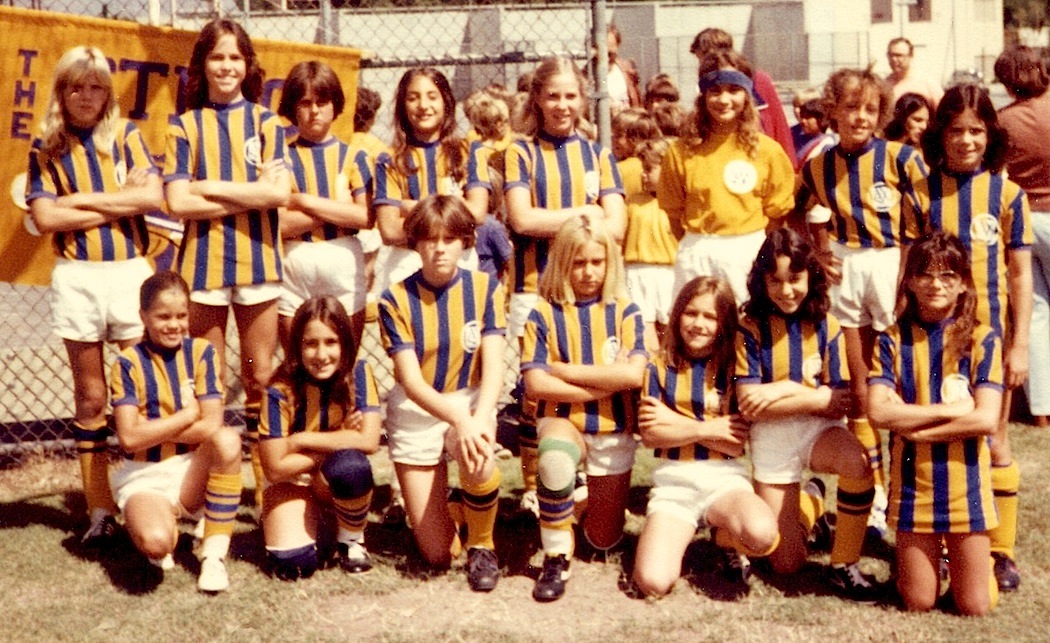
The photo above was one of my girls soccer teams--The Sting--about 1977.  Pamela, my daughter, is fourth from the left in the back row.  I cheated a little bit and recruited some of these girls from my track team.  We weren't very good, but we sure had fun.


My primary sport in high school and the army was track, so coaching youth track and field was a natural for me and it's a good fit with soccer.  The photo above was my 1976 Mitey Mite team on the West Valley Eagles.


One of the most fun groups of kids I ever coached was a boys team The Magic in 1981.  Adam, my youngest son, is on the far right of the back row.  I am on the far right in that row.


In 1975 a bunch of enthusiastic soccer dads and a few expatriate Brits formed an over 30 (years old) soccer team.  The club became known as the Woodland Hills Football Club (WHFC), but the team's nickname was the Choppers.  Within a year or two we developed a Southern California League comprised of 16 teams.  That's me fourth from the left in the back row in the photo above.


In 1978 the WHFC arranged a soccer tour of England and Scotland.  The photo above was taken on an extraordinarily beautiful pitch (soccer field) overlooking the ocean at the British Naval Base in Plymouth, England.  We played a group of naval officers (who were really a rugby team).  After we won 5 to 3, those British gentleman  (stripes) surrendered a ship's ensign to us "Yanks."  Later they treated us and our wives to s splendid evening at the officer's club.  I'm seventh from the left in the photo above.


In 1981 I learned about an under16 (years old) boys soccer team from Santa Barbara, California that needed a licensed coach to chaperone them on a tour of Germany.  I signed on and spent two weeks living with three different German families.  For me the best part of the trip was playing with SV Altenessen 1912's over 30s team.  I'm second from the right in the front row of the photo above.

My daughter Pam was the captain of her college team at UCLA

My two favorite television sports are still any rodeo and English Premier league soccer.

Thursday, November 10, 2011

Meanwhile back at the ranch -- Lone Ranger Rock

In an earlier post I told readers about the Iverson movie location ranch in Chatsworth, California.  See http://a-drifting-cowboy.blogspot.com/2011/10/iverson-movie-location-ranch-chatsworth.html


Now I'd like to show you one of the most famous landmarks in movie history.  It's the "Lone Ranger Rock."  If you're old enough, you may remember seeing it in--each and every opening scene--on the Lone Ranger TV Show.


It's still there for all to see in the "Garden of the Gods" State Park (center of the photo above).  It's on the east side of Redmesa Road just north of Santa Susana Pass Road in Chatsworth.


A few of the movies it showed up in are (clockwise from top left) Land Beyond the Law (1937) with Dick Foran;The Oklahoma Kid (1939) with James Cagney; Wall Street Cowboy (1939) with Roy Rogers; and the serial Perils of Nyoka (1942) with Kay Aldridge as Nyoka the Jungle Girl.


The rock formation was seen in some silent film era movies, including Ben-Hur: A Tale of the Christ (1925).


YouTube video clip of the Lone Ranger rock on the Iverson Movie Location Ranch in Chatsworth, California.  See: http://youtu.be/T2DUfQl2ei0


To learn more about my research, and the books I've written about the Iverson Movie Location Ranch, and other Chatsworth, California filming locations see http://www.cowboyup.com/

Cowboy Legacy -- Be all you can


I was a member of the Seventh Special Forces Group (Airborne) in the early 1960s.  When I was 20 years old jumping out of an airplane seemed like a good idea.  It was quite a thrill to jump out the door and get swept away by a 125 mph prop blast.  Four seconds later, it was just a serene trip to the drop zone--that is if it wasn't windy.


I never jumped in one of the modern free-fall parachutes.  We used a static-line that opened the parachute when you exited the aircraft.  Those old T-10 parachutes pretty much went where the wind pushed them.  We could "slip" by pulling on the risers, but from 1200 feet you couldn't go far in any direction.


I jumped from several different aircraft including C-119 (flying boxcar in the photo above), C-124, C-130, Cariboo (what ever number it was), C-47, and CH-34 helicopters.


I was stationed at Fort Ord, California when the Cuban missile crisis occurred.  I was so ill prepared, it scared the heck out of me, so I volunteered to join special forces so I would be better trained in the event of a war.


After going to parachute "jump school" at Fort Benning, Georgia, I was stationed at Fort Bragg, North Carolina, where I spent the next two years.  I was discharged in December, 1964.  Looking back I was very fortunate not to have been deployed to  Vietnam, a war that was one of this country's biggest regrets.  At least I served with the best the Army could produce.


JFK and the GREEN BERETS


"A symbol of excellence, a badge of courage, a mark of distinction in the fight for freedom." — President Kennedy on the Green Berets, April 11, 1962


President John F. Kennedy was visionary in his efforts to increase the capability of the United States Department of Defense in the conduct of Counter Insurgency and Unconventional Warfare. He recognized the unique capabilities and value of US Army Special Forces -“Green Berets”- in the struggle against despotic insurgency, and ensured their predominance in his global initiatives for freedom.


On October 12, 1961 the president visited Fort Bragg and the US Army Special Warfare Center, home of Army Special Forces. In the course of their meeting, the President asked * Brigadier (then) General William P. Yarborough, “Those are nice. How do you like the Green Beret?" General Yarborough replied, "They're fine, Sir. We've wanted them a long time."


After an impressive capabilities demonstration by General Yarborough and his “Green Berets,” the Commander in Chief sent a message to the General which read in part:

The challenge of this old but new form of operations is a real one and I know that you and the members of your Command will carry on for us and the free world in a manner which is both worthy and inspiring. I am sure that the Green Beret will be a mark of distinction in the trying times ahead.


Soon after, the president authorized the “Green Beret” as the official headgear for all US Army Special Forces and these Unconventional Warriors were thereafter and ever known as “The Green Berets." 


The president further showed his unfailing support for Special Forces in publishing an official White House Memorandum to the US Army dated April 11, 1962, which stated in part that “The Green Beret is again becoming a symbol of excellence, a badge of courage, a mark of distinction in the fight for freedom." 


Within two years following the president’s fateful visit to Fort Bragg, the Green Berets would expand their ranks by four additional Groups on active duty and four new Groups in the National Guard and Army Reserve. Already active in several overseas locations, Green Berets were soon deployed to an even greater number of countries and in greater strength across the globe- from Europe to Asia, throughout Central and South America and into the continent of Africa.

But a dark cloud would descend upon the Special Forces and the United States on November 22, 1963. Within hours after the president’s untimely passing, close members of the Kennedy family requested that Green Berets participate in the Honor Guard for his funeral. The Special Warfare Center immediately published orders for forty-six Green Berets to travel to Washington, DC on the following day.


On the day of the president’s funeral, a leading member of that contingent, Command Sergeant Major Francis Ruddy, removed his own Green Beret and placed it solemnly upon the president’s grave. This green beret is now on permanent display in the Museum at the John F. Kennedy Presidential Library and is displayed in memory of President Kennedy and in memory of all Special Forces soldiers, especially those who gave their lives while in service to the country. Today, the John F. Kennedy Special Warfare Center and School, located at Fort Bragg, North Carolina, serves as the Army’s special operations university.

For decades to follow, Green Berets would honor President Kennedy by laying a Green Beret wreath at his grave at Arlington National Cemetery, an honored tradition that continues to this day.


* Note: Lieutenant General William Pelham Yarborough (May 12, 1912 – December 6, 2005) was a senior United States Army officer. Yarborough designed the U.S. Army's parachutist badge, paratrooper or 'jump' boots, and the airborne jump uniform. He is known as the "Father of the Modern Green Berets."


SPECIAL FORCES PATCH AND CREST


Cowboy Legacy -- Kendrick, Idaho 1903 - 1928

Jackson Bailey on front porch with grand babies (about 1925).

In an earlier post I introduced you to Jackson Bailey and his wife Lillian.  See http://a-drifting-cowboy.blogspot.com/2011/10/cowboy-legacy-nebraska-1869-to-idaho.html

Turn-of-the-century aerial view of Kendrick, Idaho
In this post we'll examine the twenty-five years he lived in Kendrick, Idaho between 1903, when he first homesteaded there, and 1928 when he retired on a small five acre plot in Lewiston, Idaho.


1908 photo above (front row L - R) Curtis Bailey, David Jackson Bailey, Lillian Amanda (Pierce) Bailey, and Clara Bailey (back row L - R) Frank Bailey, Marcus Bailey, Meda Bailey, David Bailey and George Frederick Bailey.  Funny how you can study these old photos, and suddenly you spot something new--the front row are sitting on an elk hide.


I don't know if Jackson was engaged in the firewood business, the way his son Frank had been in Kalispell, Montana about 1914, or if this 1920s photo is just a glimpse at a family operation.  Either way he had a pretty sophisticated rail system to move logs, so they could use a two-man crosscut saw to cut them.  I'd bet my bottom dollar those draft horses are Belgians.


Here's another great 1920s photo of Jackson and his sons baling hay.  They forked the hay into a trough, then swung the horses in an arc pulling a piston drive mechanism that compressed the hay bale.  Granddad is on the far left.  Jackson is second from the right.  I'm not sure, but I think the other boys might be David, and George.


This final photo from the 1920s gives us a good view of a major portion of the 160 acre Kendrick homestead.  Jackson lived until 1949, and I don't believe he ever owned an automobile.  My uncle Vernon told me he could remember his granddad (Jackson) coming for a visit.  He said, "You could always spot him on a distant ridge where he'd dismount, and walk his horse to cool him off, and he always had one or two of his dogs trailing' behind."